AgentCash + Rye: Physical Commerce for Agents on x402
Arjun Bhargava
Co-founder and CEO @ Rye
6 minutes read
AgentCash and Rye bring x402 to physical commerce. One wallet, one install — agents go from product discovery to delivered order across the merchant web, all over HTTP.
TL;DR / Key Takeaways
Rye's Universal Checkout API now accepts x402 payments via AgentCash. One wallet, one install, and your agent can buy anything on the internet.
x402 is the open payment protocol that uses the HTTP 402 status code to embed stablecoin payments directly into web requests. Over 100 million payments processed since May 2025.
AgentCash is the most widely used x402 client — an MCP server that manages your agent's wallet, handles payment signing, and discovers payable APIs. Rye is the first universal checkout platform with native x402 support for physical commerce.
Together: your agent discovers a product, AgentCash handles the payment, and Rye executes the purchase on any merchant site. No card tokens. No vault setup. No payment provider accounts.
Launching on Base, Solana, and Tempo, with USDC as the supported stablecoin. Get started →
Why x402 Matters for Physical Commerce
x402 has processed over 100 million payments since launch — almost entirely for digital services. API calls, compute time, data enrichment. Pay a few cents, get a response. The protocol works beautifully when the product is information.
Physical commerce has been the missing piece. An agent could pay pennies for an API call, but it couldn't buy a case of Diet Cokes for the office. The product catalog of the entire internet — 15,000+ merchants — was locked behind credit card forms and payment provider accounts that agents can't navigate.
That changes today. Rye brings x402 into physical commerce, and AgentCash brings the wallet infrastructure that makes it work end to end.
If you're building agents that need to buy things in the real world, this is the integration that closes the loop. Your agent goes from intent — "order more printer paper" — to a confirmed purchase with a tracking number. No human in the loop.
How AgentCash and Rye Work Together
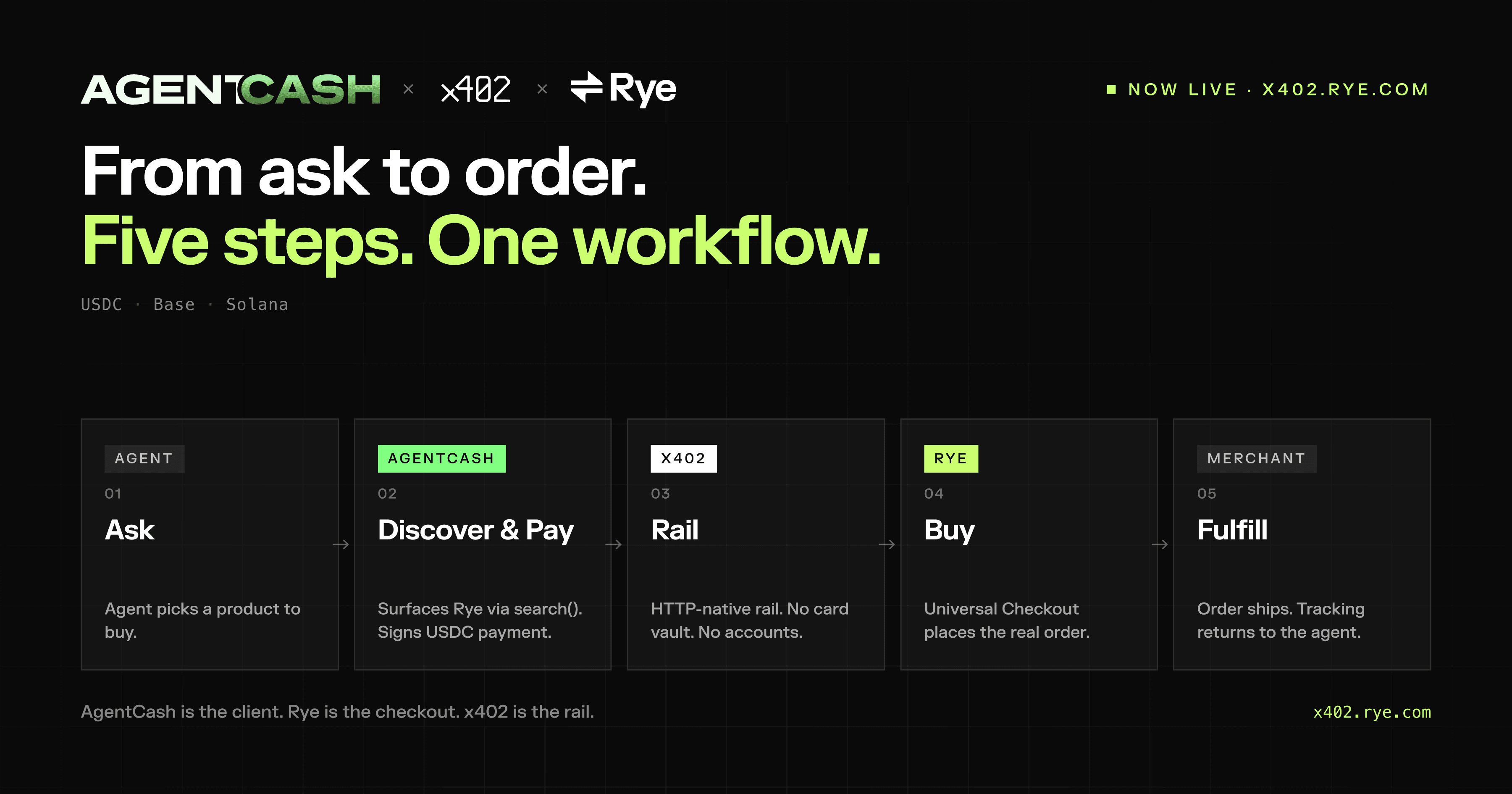
The setup is straightforward. AgentCash handles the wallet. Rye handles the checkout. x402 connects them over HTTP.
1. Agent discovers a product via AgentCash.
Any agent with AgentCash installed can find Rye through AgentCash's discovery layer — search() surfaces Rye's checkout endpoint alongside the long tail of payable APIs. Your agent identifies the product it needs to buy, then sends a product URL plus buyer details to Rye's checkout endpoint.
2. Rye responds with a price.
Rye creates an offer with the exact total — product price, shipping, and tax — and responds with 402 Payment Required. The response includes accepted networks (Base, Solana, and Tempo) and USDC as the accepted token.
3. AgentCash signs and pays.
AgentCash manages the wallet interaction. It signs a USDC payment for the exact amount and resends the request with a payment signature. No manual wallet management, no key handling in your agent code.
4. Rye verifies and fulfills.
Rye verifies the payment, settles, and executes the checkout — navigating the merchant's site, completing the purchase, and returning order confirmation with tracking. The same Universal Checkout API that handles 15,000+ merchants.
x402 calls on Rye are priced per request and settled in USDC: $0.02 to create a checkout intent, $0.03 to confirm and place the order. Reads in between are free.
What Agents Can Do With AgentCash and Rye
With AgentCash and Rye in place, an agent can:
Buy from across the merchant web. Rye's checkout covers 15,000+ merchant sites. Your agent sends a product URL, AgentCash handles payment, Rye handles fulfillment.
Skip every piece of payment infrastructure. No Stripe account. No card vault. No PCI compliance surface. AgentCash holds the wallet, and your agent signs payments directly from it — the wallet signature is the credential. No card data to store, no payment provider account to maintain.
Go from intent to purchase in a single workflow. AgentCash gives your agent access to the long tail of x402 resources, Rye included. The moment AgentCash is installed, every physical good in Rye's catalog becomes purchasable: discovery, price verification, payment, and order confirmation all happen over HTTP, in one continuous flow.
Operate at micro-transaction scale. x402's per-transaction model means agents can make small purchases without minimum order friction. Need one item? Buy one item. Need fifty across twelve merchants? Run them in parallel.
End-to-End on x402
This is the pattern that the agentic commerce ecosystem has been building toward:
Agent encounters a task that requires a purchase
Agent discovers the right product via Rye's Product Data API — price, availability, shipping options
Agent pays via AgentCash's x402 wallet — USDC, signed over HTTP
Rye executes the checkout on any merchant site
Agent receives order confirmation and tracking
Every step is HTTP-native. Every step works across any merchant. One AgentCash wallet — and your agent can buy anything on the internet.
Why AgentCash
We partnered with AgentCash because they've solved the hardest part of the x402 experience: getting agents and users from zero to transacting.
AgentCash is both the most widely used x402 client and the discovery layer for payable APIs. They've built a heavily optimized onboarding flow — install an MCP server, fund a wallet, and your agent is ready to make paid calls. Their work brings the highest-quality resources into open agentic commerce, and Rye now sits inside that catalog as the checkout layer for physical goods.
For Rye, AgentCash is the preferred client for x402 payments. Their wallet infrastructure, onboarding loop, and partner ecosystem mean that the path from "I want my agent to buy things" to "my agent is buying things" is as short as possible.
The way we see it: agents are your first customers. Your agent reads the Rye docs, finds a product, and asks if you want to buy it. AgentCash is what makes that transaction happen.
Frequently Asked Questions
Do I need AgentCash to use x402 on Rye?
AgentCash is the preferred and recommended client, but Rye's x402 endpoint follows the open x402 standard. Any compliant x402 wallet can interact with it. AgentCash provides the smoothest experience — wallet management, automatic payment signing, and discovery — out of the box.
Can I use x402 with my existing Rye API key?
Yes. x402 is also available as a payment method on the standard Universal Checkout API at /v1/checkout-intents/:id/confirm. The dedicated x402.rye.com endpoint is built for clients without a Rye API key — typically AI agents holding a crypto wallet. Existing API key holders can adopt x402 without switching endpoints.
Do I need a crypto wallet to use Rye?
No. x402 via AgentCash is an additional payment option. Rye continues to support all existing payment methods — Stripe, Basis Theory, manual card tokens, and Pay by Invoice. Use whichever fits your application.
Which stablecoins and chains are supported?
At launch: USDC on Base, Solana, and Tempo. Additional chains and stablecoins may be added based on developer demand.
Does x402 change how checkout works?
No. The checkout execution — navigating the merchant's site, completing the purchase, handling shipping and tax — is identical whether you pay with a Stripe token or an x402 payment. Same Universal Checkout API, same reliability, same merchant coverage.
What are the transaction fees?
x402 calls on Rye are priced per request and settled in USDC: $0.02 to create a checkout intent, free to read its state, and the purchase total plus $0.03 to confirm and place the order. Blockchain network fees apply on top. Full fee schedule in the x402 docs.
Getting Started
If you're already using AgentCash, Rye's x402 endpoint is available today. Your agent can discover it automatically via search() or you can point it directly at x402.rye.com.
If you're new to AgentCash: get started here. One balance, one install, and your agent can access Rye plus thousands of other premium APIs.
If you're new to Rye: explore the Universal Checkout API, get started with x402, or read the x402 docs.